Blogging
How to Start a Book Blog in 2026 (Step-by-Step Guide)
Every book blog that's still around three years later started the exact same way every book blog that quietly died did — with a first post nobody read. The difference wasn't talent or luck. It was a plan: a niche narrow enough to actually rank and build an audience, a platform that didn't fight them the whole way, and a publishing cadence they could actually keep up. That's the whole plan below, minus the parts that don't matter.
Quick answer
Pick a specific niche, build on WordPress.org with a cheap host, publish 5 pillar posts before you tell anyone it exists, and start collecting emails from post one. Everything else — design, social, monetization — comes after those four things are actually in place.
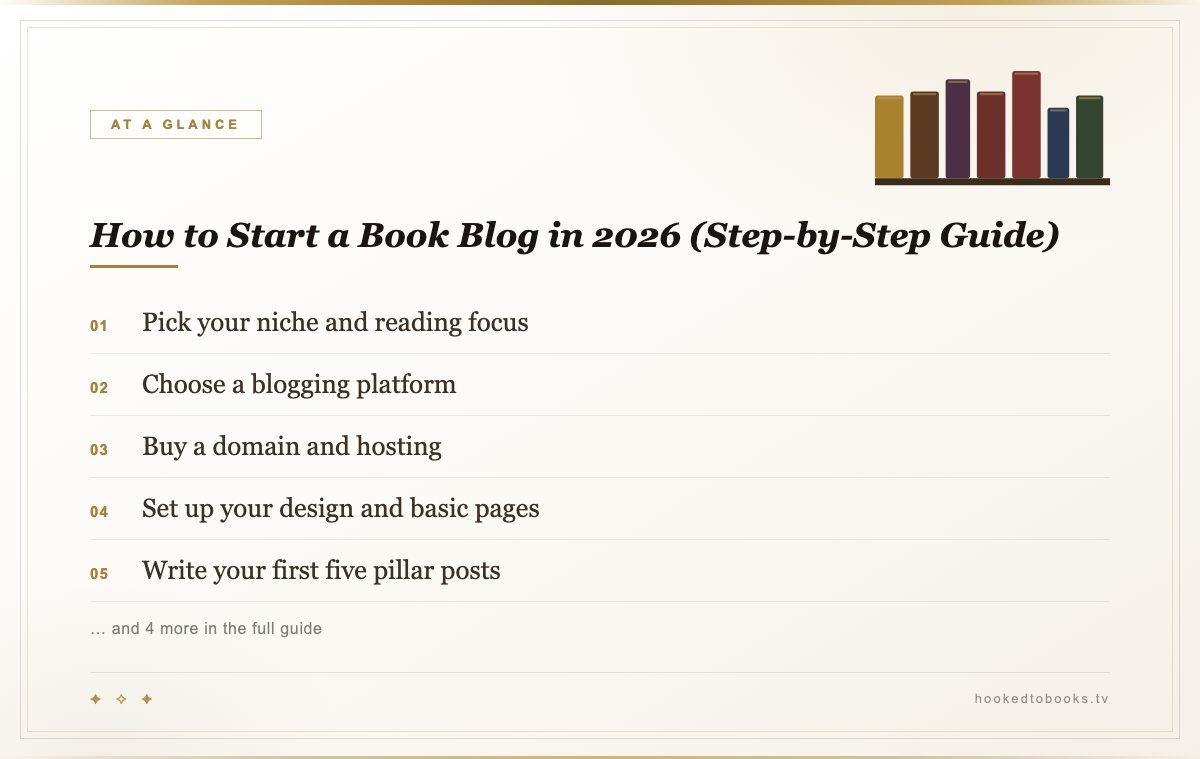
The 9 Steps at a Glance
1. Pick Your Niche and Reading Focus
"A blog about books" is too wide to grow fast. "Cozy fantasy for anxious readers," "audiobooks for a two-book-a-week commute," or "romantasy new releases, ranked" are all specific enough that search engines, Pinterest, and actual humans can immediately tell who the blog is for. Pick the genre or angle you already talk about unprompted — that's usually the real niche, not the one that looks most "marketable" on paper.
2. Choose a Blogging Platform
WordPress.org (self-hosted) is still the default for anyone serious about long-term SEO and eventual ad revenue — it's flexible, it's what most affiliate networks expect, and you own the whole thing outright. Substack is the faster, lower-friction option if your priority is a newsletter-first audience over search traffic. Squarespace or Wix trade some flexibility for a much gentler learning curve if code and plugins aren't your thing. There's no wrong answer here as long as you actually launch instead of relaunching in a different platform every three weeks.
3. Buy a Domain and Hosting
Get a domain that matches your niche or your name, not something you'll want to change in a year. A .com is worth the extra couple dollars over a novelty extension for anything you want ranking on Google long-term. For hosting, budget shared hosting is genuinely fine to start — you can always upgrade once traffic actually justifies it. Don't over-invest in server infrastructure before you've published a single post.
4. Set Up Your Design and Basic Pages
You need four pages before launch: a homepage, an About page that explains who you are and what you read, a Contact page (a contact form, never a raw email address, keeps spam and scrapers down), and a disclosure page if you plan to run affiliate links. Pick a free or low-cost theme built for blogging, not a heavily customized design — you can always upgrade the look once you know the blog is sticking.
5. Write Your First Five Pillar Posts
Launch with five solid posts, not one. A single post makes a blog look empty; five gives a new visitor something to actually click into next. Good starter formats: a "best of" list in your niche, a reading order guide for a popular series, a "books like X" comparison post, a personal ranked list, and one deeply personal post about why you started the blog. List posts and reading-order guides tend to be the fastest to rank because they match exactly what people search for.
6. Build an Email List From Day One
Social platforms and search rankings both change on someone else's schedule. An email list is the one audience you actually own. Put a simple opt-in on your homepage and at the end of every post — even something as basic as "get notified when I post a new list" beats having no list at all six months in, when you finally wish you'd started one.
7. Join Affiliate Programs
Amazon Associates is the standard starting point for book bloggers — free to join, and it pays a small commission any time a reader buys through your link, not just the specific book you recommended. Bookshop.org is worth adding alongside it if your audience cares about supporting independent bookstores; it pays a similar commission while sending sales to local shops instead of one retailer. Apply once you have your first five posts live, since most programs review the actual site before approving it.
8. Promote on Pinterest and Bookstagram
Pinterest is a search engine more than a social network, and book content performs exceptionally well on it — a well-tagged pin can drive traffic to a post for years, not just the day you post it. Bookstagram (Instagram) is better for building a following and community around your voice than for direct traffic, but it's where a lot of ARC and publisher relationships start. Pick one as your primary channel and treat the other as a bonus rather than splitting effort evenly across both from week one.
9. Track What Works and Publish on a Schedule
Once you're live, watch which posts actually pull traffic (Pinterest saves, search impressions, time on page) and write more of whatever's working instead of chasing every new idea. Consistency beats intensity here — a blog that publishes reliably every week for a year will almost always outperform one that publishes fifteen posts in a burst and then goes quiet.
Book Blog FAQ
How much does it cost to start a book blog?
A domain name runs about $10-15 a year, and basic hosting for a WordPress.org site is typically $3-10 a month if you shop the budget hosts. If you start on Substack or Blogger instead, it can cost nothing at all beyond the domain. Most of the real cost in book blogging is time, not money.
How do book bloggers make money?
The three most common income streams are affiliate links (Amazon Associates and Bookshop.org pay a commission when readers buy books through your links), display ads once you have enough traffic to qualify for a network, and sponsored content or ARC-review partnerships with publishers. Most book bloggers combine all three rather than relying on just one.
Do I need a niche to start a book blog?
You don't need one on day one, but picking a lane fast helps — "fantasy romance recommendations" or "audiobooks for commuters" will grow faster than "a blog about books in general," because it's easier for readers, search engines, and Pinterest to know exactly who the blog is for.
How long does it take for a book blog to make money?
Most book blogs take six months to a year of consistent posting before affiliate income becomes meaningful, and longer than that before display ads are worth turning on. The blogs that grow fastest publish on a predictable schedule and lean into one or two traffic channels instead of spreading thin across everything at once.
More Reading Life Guides
The blogs that make it aren't the ones with the best launch post — they're the ones that were still posting a year later. Pick your niche, publish five posts, and go from there.
Want a free set of printable bookmarks?
We made a set for readers who actually finish their TBR pile. Print at home, cut, and slip one into whatever you're reading tonight — totally free.
Get the free bookmarks →As an Amazon Associate, we earn from qualifying purchases.