Reading Life
How to Start a Book Club That Actually Lasts
Most book clubs die between the third and fifth meeting. Not because the books were bad, and not because people stopped liking each other — they die because nobody decided in advance who picks the books, when the group meets, or what the evening is actually for. The clubs that run for a decade aren't the ones with the most passionate readers. They're the ones with the least friction.
This is the practical version: how to find members, how big to be, how often to meet, how to choose books people will actually finish, and how to run a discussion that doesn't collapse into forty minutes of talking about someone's kitchen renovation. Everything here is designed to be decided once and then forgotten about.
We turned this whole guide into a printable. The free Book Club Kit is eight pages — a host checklist, a four-part discussion frame that works on any book, questions by genre, a fill-in reading calendar, a meeting one-pager, a book pick ballot and a twelve-book tracker.
Step 1: Decide what kind of club you're actually starting
This is the step everyone skips, and it's the reason for most quiet resentments. There are three basic kinds, and mixing them without saying so is what causes trouble.
The discussion club. The book is the point. People come having read it, arrive with things flagged, and want ninety minutes of real conversation. Snacks are incidental. This club works with harder books and needs a host willing to prepare.
The social club with a book attached. The point is seeing each other. The book is the excuse and the shared reference. Roughly half the group will have finished it. This is a perfectly legitimate and extremely durable format — it just has to be honest about itself, because a discussion-club person in a social club spends every meeting frustrated.
The themed club. A single lane: horror in October through the year, a run through the Booker shortlist, classics you were assigned in school and never read, one country's literature for twelve months. Themes solve the selection problem entirely and give the group an identity.
Say which one you are in the invitation. One sentence — “this is a book-first group, we're going to actually dig into these” or “this is mostly an excuse to see each other monthly” — sorts everyone correctly before anyone is disappointed.
Step 2: Find your members
The fastest way to a functioning club is not a public call for members. It's three people you already know will show up, each of whom brings one person. You get six committed members and a natural mix of people who don't all know each other, which is what keeps the conversation from turning into an inside-jokes session.
If you need more, in rough order of how well they work:
- Your public library. Many branches will list your club, give you a free meeting room, and — the underrated part — assemble a book-club kit of multiple copies of the same title for you. Ask the reference desk. This is a service most libraries offer and almost nobody uses.
- Your local independent bookstore. Staff know who's looking, many host clubs in-store, and most offer a book-club discount of 10–20% on the monthly title.
- Work. A lunchtime club at an office has a built-in schedule and venue, which removes two of the four things that kill clubs.
- Neighborhood apps and parent groups. Proximity matters more than you'd think — a club within walking distance survives bad weather and low motivation.
- Bookstagram, BookTok, and Goodreads groups. Best for finding people with a specific taste, particularly for genre clubs. Usually leads to virtual rather than in-person.
Do not recruit anyone who says “I'd love to but I'm so busy right now.” They are telling you the truth, and a member who attends one meeting in four drags the group's energy down more than an empty chair does.
Step 3: Get the size right
Invite ten to twelve. Expect six to eight. That's the whole rule, and it's the single most useful number in this guide.
Attendance in a healthy club runs around 60–70% on any given month — people travel, get sick, have work things. If your roster is five, one bad month leaves three people and the meeting feels thin. If your roster is eighteen, everyone shows up once and the room splits into three separate conversations, which is a party, not a book club.
Six to eight in the room is the magic zone: large enough that a range of opinions surfaces, small enough that a single conversation holds and nobody gets to hide for ninety minutes without speaking.
Step 4: Set the cadence and never negotiate it again
Monthly, on a fixed weekday. The second Tuesday. The last Sunday afternoon. A recurring date beats a scheduled one every time, because the moment a group starts polling for availability each month, the club has acquired an administrative burden that will eventually kill it.
A month gives most readers enough runway for a 300–400 page book without it feeling like an assignment. If your group is reading long or difficult books — nineteenth-century novels, dense nonfiction, anything over 500 pages — six weeks is the better interval. Weekly clubs almost never survive their first busy season.
Put twelve dates on a shared calendar in the first week. Send invitations for all of them at once. This one act of front-loading does more for a club's survival than anything else on this page.
Step 5: Choose the books
As founder, pick the first three yourself. Democracy is for later. The club needs momentum before it needs process, and three consecutive books you're confident will spark discussion will do more to establish the group than a fair selection procedure will.
After that, pick a system and stick to it:
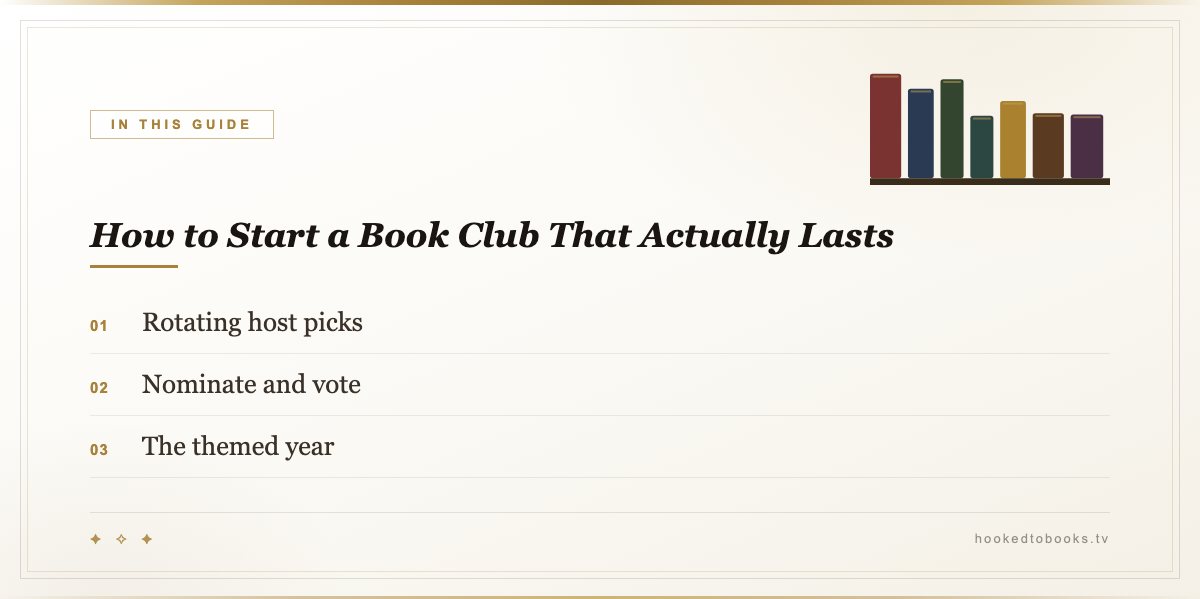
Rotating host picks
Whoever hosts chooses the next book. The rotation runs in a fixed order so everyone knows their turn is coming. This is the most durable system in practice — it distributes both the work and the taste, guarantees you'll read things you'd never have chosen, and eliminates the monthly negotiation entirely. The rule that makes it work: no vetoing someone else's pick. You read it, and if you hate it, hating it together is a good meeting.
Nominate and vote
Each member proposes one title; the group votes; top two become the next two months. More democratic, more work, and it reliably converges on whatever is safest and most popular. Use it if your group has strong opinions about what it won't read.
The themed year
Decide in January: twelve books, one theme, done. Nobel winners. Books set in a place you'll never visit. Debut novels only. The entire selection problem disappears for a year, and the group develops a real identity.
What makes a good book-club book
Not “the best book.” The best book-club books are the ones with something to argue about — a character who did something defensible-but-awful, a structural choice you can debate, an ending that splits the room. A flawless, universally loved novel produces a twelve-minute meeting of everyone agreeing it was lovely.
Practical constraints that matter more than they should: under 400 pages, available in paperback and at the library, and out for at least a few months so there are copies to be had. We've put together a list of the best books to read with your book club — every title on it is chosen specifically for how well it discusses, with a sample question for each.
Step 6: Run the discussion
Never open with “So, did everyone like it?” It produces five people saying “yeah, it was good” and a dead room. Verdicts are the end of a conversation, not the beginning.
Prepare five to eight questions and move through them in this order — this is the framework that reliably produces ninety minutes:
- The easy opener. Something everyone can answer in one sentence with no interpretation required. “What's the first scene you'd put in the movie?” “Which character would you least want to sit next to on a flight?” Its only job is to get every voice into the room in the first five minutes.
- The passage. Someone reads a short marked passage aloud — half a page. Reading aloud changes the temperature of a room instantly and grounds the discussion in the actual text rather than in vague memory.
- The interpretive question. The one with no correct answer. “Was what she did forgivable?” “Is the narrator lying to us, or to himself?” This is where the real discussion lives, and it should take up a third of the meeting.
- The craft question. Why did the author do it that way? The nonlinear timeline, the second-person chapter, the refusal to resolve the subplot. Even readers who don't think of themselves as analytical have opinions here once asked.
- The personal question. “Have you ever been in a version of this situation?” Saved for last, because it changes the register of the room and it's hard to get back to the text afterward. It's also usually the part people remember.
- The closer. One sentence each: what will you still remember about this book in a year? It gives everyone a final turn and makes a clean ending.
The host's real job is not to lecture — it's to notice who hasn't spoken in twenty minutes and ask them something directly, and to cut off the tangent at minute forty. Both are small acts of rudeness that make the meeting work. Rotating the host means nobody has to be the enforcer forever.
One more thing worth deciding early: the phone rule. Most groups settle on phones face-down unless someone's looking up a passage. It's a small thing that visibly changes how present the room is.
Virtual vs. in person
In person is better for discussion. People interrupt, laugh, pass the book around, break into pairs during a lull and rejoin. Almost none of that survives a video call. If everyone lives within thirty minutes of each other, meet in person.
Virtual wins on logistics and geography, and it's the only option for a club drawn from the internet or scattered across time zones. It needs three adjustments to work:
- Cap it at 75 minutes. Video fatigue is real, and a two-hour call that would have flown by in a living room becomes an endurance event.
- Keep it under eight people. A video call physically supports one conversation at a time, so the fragmentation ceiling is lower.
- Moderate actively. Call on people by name. The natural cues that let people take turns in person — the small lean forward, the intake of breath — are invisible on video, so quiet members stay quiet unless invited.
Hybrid is the worst of both and should be avoided if possible. The remote members become spectators. If someone has to dial in occasionally, put the laptop at the table facing the group and give that person the first word on every question.
Your first-meeting checklist
Print this, or just work down it:
- The book is confirmed and everyone has a copy. Send the title, the edition, and a library link at least four weeks out.
- The date, time, and address went out twice — once when you scheduled it, once two days before.
- You have five to eight questions written down. On paper. You will not remember them.
- One passage is marked to read aloud.
- Snacks and drinks are handled and low-effort. Do not set a hosting bar the next host can't clear — the club where everyone caters dinner is a club with a hosting problem within six months.
- Seating is a circle, or as close as your room allows. A row of chairs facing a couch creates an audience.
- The clock is decided: 30 minutes of arriving and catching up, 60 on the book, 10 on logistics. Say it out loud at the start so the transition into the book isn't awkward.
- The next book and next date get chosen before anyone leaves. This is the single most important item on the list. A club that ends its meeting with “we'll figure it out in the group chat” has just introduced the exact friction that kills clubs.
- Somebody wrote it down and sent it to the grou p that night.
The failure modes, and how to fix them
Nobody finished the book. Say so at the top so nobody has to bluff, then discuss it anyway — where people stopped and why is frequently a better conversation than the plot would have been. If it happens three months running, your picks are too long or too heavy. Assign a 250-page novel next.
One person talks the whole time. Go around the circle for one question, in order, one answer each. It feels artificial for about ninety seconds and then it fixes the room.
The conversation never gets to the book. Hard-start the discussion at a fixed time and let the host say “okay — book.” Building thirty minutes of social time into the schedule is what makes this possible without anyone feeling shut down.
Attendance is drifting. Almost always a scheduling problem, not an interest problem. Ask the group directly whether the day of the week still works, and be willing to move it permanently.
The group has quietly become a social club. That's fine. Say it out loud, pick shorter books, and stop feeling guilty. A group of friends who see each other monthly for ten years is a better outcome than a rigorous literary society that folded in March.
Book club FAQ
How many people should be in a book club?
Invite ten to twelve so that six to eight attend. Under five and one absence guts the night; over twelve and the room splits into side conversations.
How often should a book club meet?
Monthly, on a fixed recurring weekday. Six weeks if you're reading long or difficult books. Weekly rarely survives.
Who picks the books?
Rotating host picks is the most durable system — whoever hosts chooses, in a fixed rotation, with no vetoes. It spreads the work and guarantees variety.
What if nobody finished the book?
Discuss it anyway and name it openly. Ask where people put it down and what stopped them. If it recurs, your books are too long.
Do virtual book clubs work?
Yes — capped at 75 minutes, under eight people, with a host who actively calls on people by name.
Should the club have rules?
Three, and only three: a fixed date, a fixed selection system, and no vetoing someone else's pick. Everything else can stay informal.
More reading guides
Start smaller than feels right, decide the boring logistics once, and pick a first book with something worth arguing about. Everything else is just showing up on the second Tuesday. Browse all our reading guides for more.
Free printable bookmarks for your club
Print a set, cut them, and hand one to every member at the first meeting — a small thing that makes a new club feel real. Totally free.
Get the free bookmarks →As an Amazon Associate, we earn from qualifying purchases.