Book Lists
20 Best Books to Read With Your Book Club
The best book for a book club is not the same thing as the best book. A perfect, airtight, universally beloved novel produces a fifteen-minute meeting in which everyone says it was lovely and then talks about their weekend. What a club needs is friction: a character who does something defensible and awful, a structural trick worth arguing about, an ending that splits the room down the middle.
Every book below has that. They're arranged loosely from the most accessible to the most demanding, and each one comes with a sample discussion question you can use as-is — the kind that has no correct answer, which is the only kind worth asking. If you're building a club from scratch, start with our guide to starting a book club first, then come back here for the first three picks.
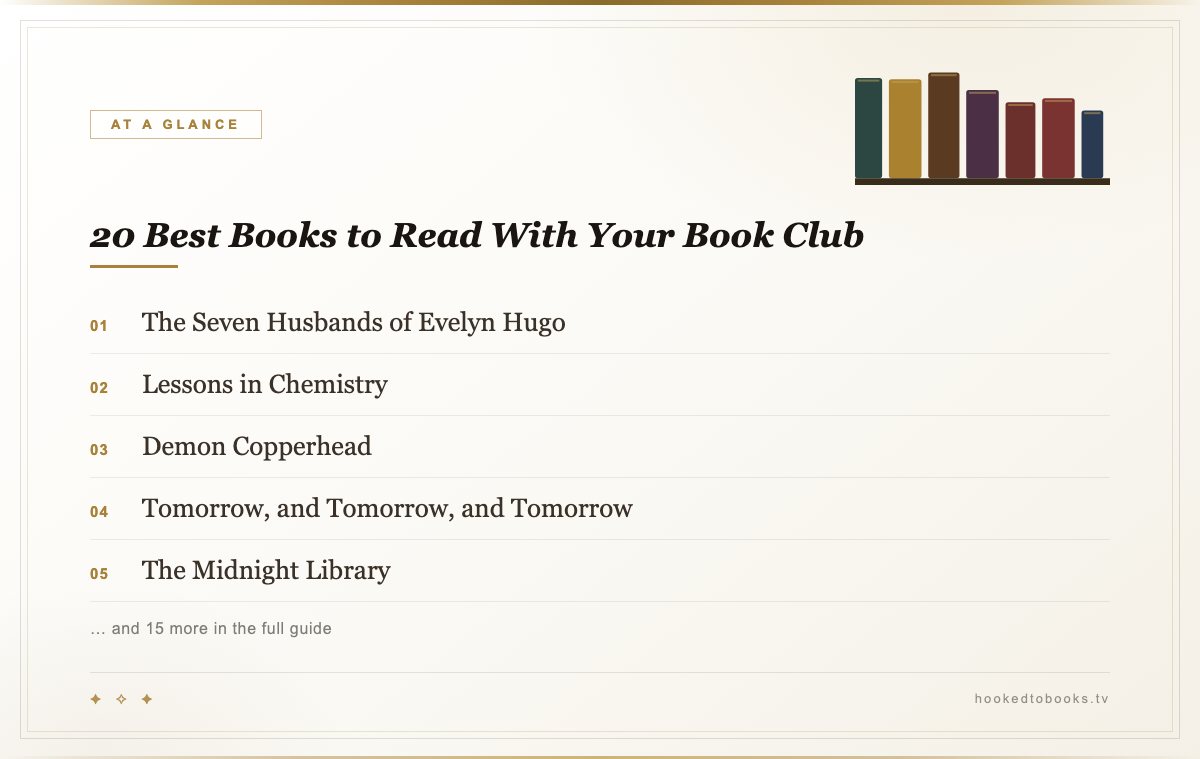
At a Glance: 20 Book Club Picks
The Crowd-Pleasers That Still Have Teeth
1. The Seven Husbands of Evelyn Hugo — Taylor Jenkins Reid
The reason this has become the default book-club novel is that it is enormously readable and genuinely morally slippery at the same time — a rare combination. Evelyn is ruthless, calculating, and asks the reader to accept her calculations as necessary; some of your members will find her a survivor and some will find her a monster, and both readings are supported by the text. The frame narrative also gives you a second layer to argue about once the plot questions are exhausted.
Evelyn insists that every marriage was a transaction she entered with open eyes. Does the novel actually agree with her — or is it showing us a woman who has told this story so many times she believes her own version?
2. Lessons in Chemistry — Bonnie Garmus
Funny enough that the members who don't usually finish will finish it, and angry enough underneath that the meeting doesn't stay light. The most productive tension in the room is usually about tone: whether the comic register makes the 1960s misogyny more devastating by contrast, or lets the reader off the hook by making it entertaining. Elizabeth Zott's refusal to compromise divides groups sharply.
Elizabeth never adjusts herself to fit the world around her, and the novel rewards her for it. Is that an honest portrait of how change happens, or a fantasy the book is offering us?
3. Demon Copperhead — Barbara Kingsolver
A Pulitzer winner that reads like a page-turner, retelling David Copperfield in the Appalachian opioid crisis. The Dickens scaffolding gives literary-minded members plenty to chase, while Demon's voice carries everyone else effortlessly. It's the rare book that makes a room talk about class and geography without anyone getting defensive, because the narrator disarms you first.
Demon repeatedly says nobody was coming to save him. Where in the book was rescue actually possible, and what specifically stopped it — a person, a system, or a decision he made?
4. Tomorrow, and Tomorrow, and Tomorrow — Gabrielle Zevin
A novel about video games that is really a novel about creative partnership, and it splits rooms beautifully because Sam and Sadie are both, at various points, insufferable. The best discussions get stuck on whether their relationship is a love story that never became one or a friendship the characters keep mislabeling. Members who have ever built something with someone else tend to get unexpectedly personal here.
Who owes the other more — Sam or Sadie? Track the ledger across the whole book and see whether your group can agree on a single tally.
5. The Midnight Library — Matt Haig
Short, fast, and structurally built for discussion — every member arrives having involuntarily made their own list of alternate lives. The book's philosophy is deliberately uncomplicated, which is its strength as a club pick: it puts the question on the table cleanly and lets the group do the complicated part. Expect at least one person to find it too tidy, which is itself a good argument.
If you could open one volume in the Midnight Library, what would the divergence point be — and is the honest answer a regret about something you did, or something you didn't?
Books That Start Real Arguments
6. The Vanishing Half — Brit Bennett
Twin sisters, one of whom passes as white and disappears from her family entirely. It's a book about identity as a choice with a cost, told across generations, and the moral question at its center — what Stella owes the people she left — genuinely divides groups. The daughters' storylines open a second front on inheritance and how much of a parent's decision a child has to carry.
Is Stella's choice a betrayal, a survival strategy, or both at once? Would your answer change if she had told her sister first?
7. Little Fires Everywhere — Celeste Ng
Purpose-built for a book club: a custody case with two sympathetic sides and a suburb full of people convinced they are the reasonable ones. Ng structures the novel so that whichever side you land on, the text has already anticipated you. It reliably produces the one thing every club wants and rarely gets — a genuine, evenly split disagreement between people who both read carefully.
Take the custody case on its own terms: who should have the baby? Then ask what in your own life made that answer feel obvious to you.
8. An American Marriage — Tayari Jones
A newlywed husband is wrongfully imprisoned; his wife builds a life without him; he comes home. There is no villain, which is exactly what makes it work — every character behaves comprehensibly and the result is still a wreck. The epistolary middle section is a gift to clubs, because you can read the letters aloud and hear the marriage come apart in real time.
Celestial is asked to put her life on hold for a sentence her husband didn't earn. What does a marriage actually obligate a person to endure — and does the novel take a position?
9. Pachinko — Min Jin Lee
Four generations of a Korean family in Japan, and one of the best multigenerational novels of the last twenty years. It gives a club something most contemporary fiction can't: a subject almost nobody in the room knows anything about, which means the whole group learns together instead of performing prior knowledge. The recurring question of what each generation sacrifices for the next carries the entire discussion.
Sunja's sacrifices are made on behalf of people who never fully understand them. Does the novel present that as tragedy, or as simply what a parent is?
10. Never Let Me Go — Kazuo Ishiguro
The quietest devastating novel on this list. Its central discussion question is unavoidable and enormous — why don't they run? — and the answers a group produces say more about the people answering than about the book. Kathy's flat, accepting narration is the craft element worth a full twenty minutes on its own.
Why don't they run? Answer it first as a fact about the characters, then as a fact about the world we live in.
11. Station Eleven — Emily St. John Mandel
A pandemic novel that is fundamentally about art rather than collapse, which makes it far warmer than its premise suggests and far more discussable than a straightforward apocalypse. The braided timeline gives structural readers something to map, and the traveling Shakespeare company's motto — survival is insufficient — is a thesis a group can genuinely disagree with.
“Survival is insufficient.” Is that true, or is it a comfortable thing to believe from a position where survival is already handled?
12. Circe — Madeline Miller
A retelling that takes a minor, villainous figure from the Odyssey and gives her an interior life across centuries. It works in clubs because half the room arrives with the Homeric version in their head and the other half doesn't, and the collision between the two readings is the discussion. The Odysseus section is the flashpoint — seeing a hero from the outside changes him considerably.
Does Circe earn her ending, or does she simply outlast everyone who could have stopped her? Is there a difference?
For Clubs That Want to Work a Little Harder
13. Trust — Hernan Diaz
Four documents telling the same story of a 1920s financier's fortune, each one undermining the last. It's the best book on this list for a club that likes to argue about form, because the entire novel is a machine for asking whose account gets believed and why. Members who read it fast and members who read it slowly will have had genuinely different books.
After all four sections, what do you actually believe happened — and which document did you decide to trust, and on what grounds?
14. Piranesi — Susanna Clarke
Short, strange, and unlike anything else your club has read — a man living alone in an infinite house of statues and tides, keeping meticulous journals. It rewards close reading enormously, since the reader understands the situation long before the narrator does. Groups that normally read realist fiction find this one an unexpectedly easy sell because it's under 250 pages.
By the end, is Piranesi better off than he was at the beginning? Consider what he gains and what he is asked to give up to get it.
15. Normal People — Sally Rooney
A polarizing pick, deliberately: some readers find it unbearably precise about how class and status shape intimacy, and others find the characters exhausting. Both camps show up prepared to defend themselves, which is the whole point. The absence of quotation marks alone will occupy ten minutes and lead somewhere more interesting than it sounds.
Marianne and Connell repeatedly fail to say the one sentence that would fix things. Is that a failure of character, of class, or of the age they are?
16. The Nightingale — Kristin Hannah
Two sisters in occupied France take opposite approaches to survival — one resists openly, one accommodates to protect her child — and the novel refuses to declare either one correct. That structural fairness is what makes it a durable club book rather than just a bestseller. It's also emotionally direct enough that it works for groups where not everyone wants a literary puzzle.
Vianne's compromises keep her daughter alive. Isabelle's defiance saves strangers. Which sister would you have been — and which do you wish you'd have been?
17. Where the Crawdads Sing — Delia Owens
Included with eyes open: it is a divisive book, and that is precisely its value in a club. The final revelation reframes everything and reliably produces a genuine split between readers who feel the novel earned it and readers who feel manipulated. The nature writing and the courtroom plot also pull in different kinds of readers, so nobody is bored.
Does the ending change how you feel about the hundred pages of sympathy the book built beforehand — and do you think it was designed to?
Nonfiction Your Club Will Actually Finish
18. Educated — Tara Westover
The memoir that converts clubs who say they don't read nonfiction. It's structured like a novel and moves like one, and it raises a question with no comfortable answer: what does a person owe a family that has actively harmed them? Westover's own uncertainty about her memories is the sophisticated part — she footnotes her doubts, which is worth discussing on its own.
Westover flags the places where her memory conflicts with her siblings'. Does that honesty make you trust the book more, or make you wonder what else is uncertain?
19. Caste: The Origins of Our Discontents — Isabel Wilkerson
Wilkerson's argument — that American racial hierarchy is better understood as a caste system, compared directly to India and Nazi Germany — is deliberately provocative and built out of narrative rather than statistics, which is why it holds a room. It is the most demanding book here in terms of what it asks of a discussion, so it belongs with a group that has already built some trust.
Does the caste framing explain something race alone doesn't — or does it flatten differences the comparison can't actually support?
20. Say Nothing — Patrick Radden Keefe
Narrative nonfiction about the Troubles in Northern Ireland that reads like a thriller and ends with a genuine unsolved question. It's an unusually good club pick because almost nobody in an American group knows the history well, so nobody can dominate the conversation on expertise, and the moral questions about political violence and about who gets to tell a story afterward are large and unresolved.
The book is built on testimony people gave believing it would stay sealed. Was publishing it justified — and does your answer depend on whether the truth it revealed was useful?
How to pick the right one for your group
If your club is brand new, start with Little Fires Everywhere or Lessons in Chemistry — both are fast, both are close to guaranteed finishes, and both produce a real disagreement without requiring anyone to feel exposed. Save Caste and An American Marriage for after the group knows each other, because the best discussions of those books require people to say true things about themselves.
If attendance is slipping, the fix is almost always length. Piranesi, The Midnight Library, and Never Let Me Go are all short enough to rescue a month where everyone is busy.
And if your group has fallen into a rut of reading the same kind of thing, Trust or Say Nothing will break it — both are far enough outside the usual book-club lane to reset what the group thinks it likes.
More reading guides
Pick the one with the most friction, not the one with the best reviews. A book everyone loved is a pleasant evening; a book half the room wants to defend is a club that's still meeting next year. More lists in all our reading guides.
Want a free set of printable bookmarks?
Print a set for the whole club, cut them, and hand one out with every new pick. Free, and they make a new group feel like a real one.
Get the free bookmarks →Taking on a long series as a group? Our Outlander books in order guide breaks it into manageable reads, and the Bridgerton books in order make a lighter pick.
As an Amazon Associate, we earn from qualifying purchases.