Reading Online
The Best Sites to Read Comic Books Online (Legally)
Comics have quietly become one of the best deals in reading. A single new issue at a shop runs four or five dollars for twenty-two pages; a subscription that costs about the same as one issue can open up seventy years of back catalog. The problem is that searching for “read comics online” drops you straight into a swamp of aggregator sites stuffed with scanned files, pop-up ads, and malware — none of which sends a cent to the writers, pencillers, inkers, colorists, and letterers who made the book.
Everything below is legitimate: licensed publisher platforms, library services funded by your taxes, original webcomic networks, and archives of genuinely public-domain material. Between them you can read more comics than you will ever finish, and a surprising amount of it costs nothing.
Short answer: If you read superhero comics, Marvel Unlimited or DC Universe Infinite is the cheapest way to read a lot. If you read manga, Shonen Jump at about $2.99 a month is the single best value in digital publishing. If you want to spend nothing, start with Hoopla and Libby using your library card.
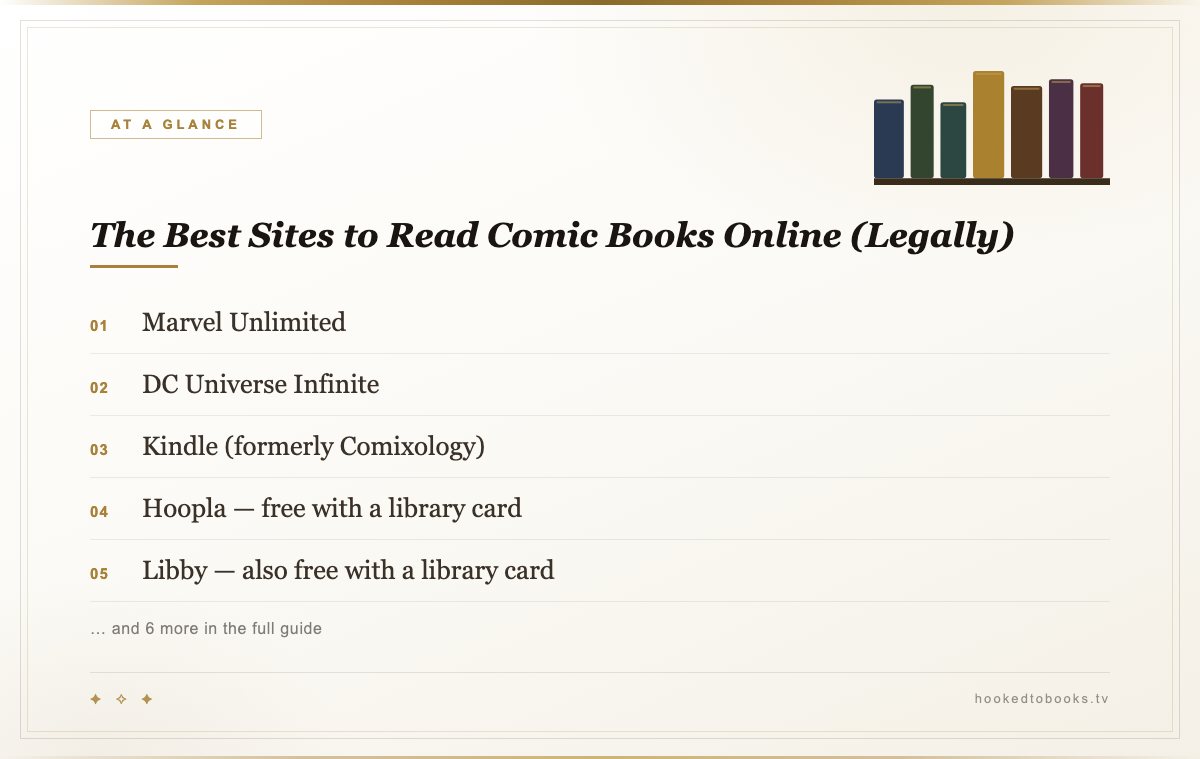
1. Marvel Unlimited
What it carries: Marvel's own back catalog — tens of thousands of issues stretching from the 1960s Lee/Kirby era through recent runs. Complete classic arcs are the draw here: Infinity Gauntlet, the Claremont X-Men years, Bendis's Daredevil, the whole tangled history of any character you can name.
Price: Around $9.99 a month, meaningfully cheaper if you pay annually. Marvel runs promotional first-month deals often enough that it is worth checking before you commit.
The catch: New issues arrive roughly three months after they hit comic shops. This is a back-catalog service, not a new-release one. If you want to be current with a running event, you will still be buying single issues somewhere else.
Who it's for: Anyone who has ever wanted to actually read the storyline a movie was based on, and anyone doing a deep-dive read of one character across decades. If you read more than two Marvel collections a year, it pays for itself.
2. DC Universe Infinite
What it carries: DC's library on the same model — Batman, Superman, Wonder Woman, plus the Vertigo material that made DC's reputation with adult readers: Sandman, Preacher, Y: The Last Man, Fables. The Vertigo catalog alone justifies a few months.
Price: A standard tier around $7.99 a month and an Ultra tier at roughly $99 a year. The tiers differ mainly in how fast new issues arrive and how deep the digital-first and Vertigo selection goes.
The catch: Same delay structure as Marvel — standard subscribers wait about six months after print, Ultra subscribers wait about one. Regional availability is narrower than Marvel Unlimited's.
Who it's for: Readers who came in through Sandman or the Batman films and want to follow the thread backward. It is also the better of the two big services for prestige, self-contained, non-superhero storytelling.
3. Kindle (formerly Comixology)
What it carries: Effectively everything — Marvel, DC, Image, Dark Horse, BOOM!, IDW, Viz manga, and a deep independent selection. Amazon acquired Comixology in 2014 and folded it into Kindle in 2023; the separate app is gone, purchases live in your Kindle library, and Comixology Unlimited was absorbed into Kindle Unlimited.
Price: Buy per issue (typically $1.99–$4.99) or per collected volume. Kindle Unlimited, around $11.99 a month, includes a large rotating selection of comics and manga at no extra cost. Publisher sales run constantly and are where the real bargains are — complete runs regularly drop to a few dollars.
The catch: You are buying licenses, not files, and the guided-view reading experience is better on a tablet than on a phone. Reading comics on a black-and-white e-ink Kindle is a compromise; a Fire tablet or an iPad is the right device.
Who it's for: Readers who want to own specific books rather than rent a whole library, and anyone chasing a title the subscription services don't carry. It is the only one of these that covers all the major publishers at once.
4. Hoopla — free with a library card
What it carries: A genuinely excellent graphic-novel collection, current and broad: Image titles like Saga and Monstress, DC and Marvel collections, huge amounts of manga, and independent and literary graphic novels. Not a back-catalog dump — real, current books.
Price: Free. Your library pays per borrow, which is why there's a monthly cap.
The catch: Most libraries limit you to somewhere between four and ten “instant borrows” per month, and comics burn through those fast because a single trade is one borrow. There's no waiting list — everything is available instantly — but the monthly ceiling is real. Loans typically run 21 days.
Who it's for: Everyone with a library card, full stop. Check whether your library subscribes before you pay for anything else. Many people qualify for cards at more than one library system, which multiplies the monthly allowance.
5. Libby — also free with a library card
What it carries: Libby (from OverDrive) is the borrowing app most libraries use for ebooks and audiobooks, and its graphic-novel and manga sections are frequently overlooked. Selection depends entirely on what your specific library has purchased.
Price: Free.
The catch: Libby uses the traditional one-copy-one-reader model, so popular titles have holds lists that can run weeks. The upside is that there's no monthly cap — if it's available, you can borrow it.
Who it's for: Pair it with Hoopla. Use Hoopla for what you want right now, Libby for things you're happy to wait on. Between the two, most readers never need to pay for a comic again unless they want to.
6. Webtoon
What it carries: Original vertical-scroll comics designed for phones, published in weekly episodes. This is where a whole generation of readers actually reads comics. Lore Olympus, True Beauty, and Tower of God all started here; so did a long tail of thousands of Canvas series from creators publishing independently.
Price: Free with ads. Coins let you unlock upcoming episodes early through Fast Pass, but virtually everything eventually becomes free.
The catch: The format is vertical scroll, not the page-based composition of traditional comics — some readers love it, some never adjust. Quality across Canvas ranges from professional to first-attempt.
Who it's for: Phone readers, romance and fantasy readers, and anyone who wants a serialized habit rather than a big finished book.
7. Tapas
What it carries: The same vertical-scroll model as Webtoon with a different creator community — more slice-of-life, more BL and romance, more prose-fiction crossover. Tapas hosts serialized novels alongside comics.
Price: Free with ads. An “ink” currency unlocks episodes early, and ink can be earned by watching ads rather than paid for.
The catch: Smaller and less polished than Webtoon overall, with a discovery problem — finding the good stuff takes browsing.
Who it's for: Readers who've exhausted Webtoon and want the next layer down, and readers specifically hunting romance and slice-of-life series.
8. GlobalComix
What it carries: An excellent middle ground — independent and mid-size publishers alongside self-publishing creators, in traditional page format rather than vertical scroll. Publishers including Mad Cave, Scout, and a rotating roster of indies put full catalogs here.
Price: A large free tier, with a premium subscription in the $8-a-month range for unlimited access to the paid catalog. Creators are paid based on reads.
The catch: You won't find Marvel or DC here. This is the indie ecosystem.
Who it's for: Readers who are tired of capes and want to find something nobody has recommended to them yet. The reading interface is also one of the better ones on the web.
9. Shonen Jump (Viz Media)
What it carries: The complete Weekly Shonen Jump vault — One Piece, Naruto, Bleach, Dragon Ball, My Hero Academia, Jujutsu Kaisen, Demon Slayer — plus new chapters the same day they publish in Japan.
Price: About $2.99 a month. For the volume of material involved, this is the single best value in digital reading. The three newest and three oldest chapters of most series are readable free without any subscription.
The catch: It is Viz's catalog, so manga from other publishers isn't here. Some titles are chapter-limited rather than fully unlocked.
Who it's for: Anyone who has watched an anime and wants to read ahead. Also worth knowing: Manga Plus, run by Shueisha directly, posts new chapters of many of the same series free on release day — a completely legal way to stay current at zero cost.
10. Comic Book Plus
What it carries: Tens of thousands of Golden Age comics whose copyrights lapsed — 1930s through 1950s crime, horror, romance, war, funny animal, and superhero books from publishers that no longer exist. Early EC horror, Fawcett's Captain Marvel, and a great deal of strange, wonderful material that never got reprinted anywhere.
Price: Free, legally, forever. These books are in the public domain.
The catch: Scans vary in quality, and the comics themselves carry the attitudes of their era — some of it is genuinely ugly by modern standards. Navigation is dated.
Who it's for: Comics historians, artists studying old layout and coloring, and anyone curious what the medium looked like before the Comics Code sanded it down.
11. Digital Comic Museum
What it carries: The same territory as Comic Book Plus with a different collection and a stricter public-domain policy. Volunteer-scanned, carefully catalogued, and searchable by publisher and genre.
Price: Free with a registration.
The catch: Downloads are CBZ and CBR files, so you need a comic reader app — not an in-browser experience.
Who it's for: The same crowd as above. Between the two archives, the pre-1959 American comics landscape is essentially fully a vailable at no cost.
Two more worth knowing
Panel Syndicate publishes creator-owned digital comics on a name-your-price model, including work from major writers who wanted to skip publishers entirely. You can pay zero and it is entirely above board. Publisher newsletters — Image, Dark Horse, and BOOM! in particular — regularly give away first issues in DRM-free formats to hook new readers, which is a legitimate and underused way to sample a lot of series for nothing.
Why the aggregator sites aren't on this list
Sites that host scanned copies of current releases are not a gray area. They're distributing files the publisher never licensed, and comics are an unusually fragile business — a mid-list book that misses its sales floor gets cancelled, and the artist loses their income. The economics are thin enough that piracy visibly kills series. Those sites are also a reliable vector for malware and credential-stealing ads, which is a practical reason on top of the ethical one.
Given that Hoopla, Libby, Webtoon, Manga Plus, Comic Book Plus, and the Digital Comic Museum are all free, there is genuinely no gap the pirate sites fill.
How to choose in thirty seconds
- You want to spend nothing: Hoopla + Libby with a library card, then Webtoon and Manga Plus.
- You want Marvel or DC back catalog: Marvel Unlimited or DC Universe Infinite, whichever publisher you actually read.
- You read manga: Shonen Jump, plus Manga Plus for free same-day chapters.
- You want to own specific books: Kindle, and wait for a publisher sale.
- You want something new and independent: GlobalComix.
- You're curious about comics history: Comic Book Plus and the Digital Comic Museum.
A note on devices
Comics need color and screen area. A phone works fine for vertical-scroll webtoons, which were designed for it, but traditional page-based comics on a phone mean either squinting or panel-by-panel guided view. A tablet in the 10-inch range is the sweet spot — an iPad, a Fire tablet, or any decent Android tablet. Standard e-ink Kindles are the wrong tool: black and white, slow refresh, and too small for a full page. If comics are going to be a real habit, the tablet matters more than which service you pick.
Comics FAQ
Can you read comic books online for free legally?
Yes, and more than you'd expect. Hoopla and Libby lend current graphic novels free with a library card. Webtoon and Tapas publish thousands of original series free with ads. Comic Book Plus and the Digital Comic Museum host tens of thousands of public-domain Golden Age comics. Manga Plus posts new chapters of major Shueisha series free on release day.
Is Marvel Unlimited worth it?
If you read more than about two Marvel collections a year, yes — it costs roughly what one trade paperback costs and opens tens of thousands of issues. The tradeoff is the roughly three-month delay behind print, which makes it a back-catalog service rather than a way to stay current.
What happened to Comixology?
Amazon bought it in 2014 and folded it into Kindle in 2023. The standalone app was retired, purchases moved into the Kindle library, and Comixology Unlimited was absorbed into Kindle Unlimited. Existing purchases carried over.
Where can I read manga online legally?
Viz's Shonen Jump app for about $2.99 a month is the best value. Manga Plus, run by Shueisha, is free. Kindle sells individual volumes, and most public libraries carry substantial manga collections through Hoopla and Libby.
Do I need a subscription to read comics online?
No. A library card plus Webtoon and Manga Plus covers an enormous amount of reading at zero cost. Subscriptions make sense when you want a specific publisher's back catalog or you're reading fast enough to blow through Hoopla's monthly cap.
More reading guides
The best comics reading setup for most people costs nothing: a library card, a tablet, and about ten minutes spent finding out which services your library already pays for. Start there, and only subscribe when you've found the specific hole you need to fill.
Want a free set of printable bookmarks?
We made a set for readers who actually finish their TBR pile. Print at home, cut, and slip one into whatever you're reading tonight — totally free. Then browse all our reading guides.
Get the free bookmarks →Prices and catalog details change; check each service before subscribing. As an Amazon Associate, we earn from qualifying purchases.