Reading Life
How to Recycle Hardcover Books (Without Wasting Them)
There is a specific guilt that comes with a box of hardcovers you no longer want. Throwing away a book feels wrong in a way that throwing away almost nothing else does — and then you look up your city's recycling rules and discover that the bin doesn't want them either. So the box sits in the garage for another year.
Here's the actual answer, in order: most of those books should be donated, not recycled. The ones nobody will take can be recycled, but only after you spend two minutes with a utility knife. And a handful should honestly just go in the trash, which is fine and not a moral failure. Below is how to sort them and what to do with each pile.
The thirty-second version: Donate anything readable. For the rest, cut the covers off — the block of pages recycles as ordinary paper, the case does not. Mold or water damage means trash, always, no exceptions.
Why hardcovers can't go in the bin as-is
A paperback is essentially just paper. A hardcover isn't. What looks like one object is really three materials glued together:
- The boards. The stiff panels front and back are binder's board or greyboard — a dense, heavily compressed chipboard. It's paper-derived, but it's not the fiber grade a mill wants, and it's saturated with adhesive.
- The covering. Wrapped over those boards is book cloth, a laminated printed paper, or a vinyl leatherette. Cloth and vinyl are not paper at all. Laminated paper is paper with a plastic film bonded to it, which is arguably worse for a pulping process than plain plastic, because it looks like paper going in.
- The adhesive and gauze. Modern hardcovers are held together at the spine with hot-melt adhesive and a strip of gauze or crash cloth. Adhesives are the classic contaminant in paper recycling — the industry calls the resulting sticky residue “stickies,” and they foul the screens and rollers in a paper mill.
Put a whole hardcover in the mixed-paper stream and one of two things happens: it gets pulled off the sort line by hand and landfilled anyway, or it goes through and adds contamination to a bale. Neither helps. That's why nearly every municipal program in the US that mentions hardcovers at all says the same thing: remove the cover first.
Paperbacks are different. Most curbside programs accept paperbacks whole, spine glue included, because the ratio of adhesive to paper is low enough to tolerate. Check your local rules — but as a general matter, a paperback goes in the bin and a hardcover does not.
How to strip a hardcover in two minutes
You need a utility knife or box cutter and a surface you don't mind scoring. Scissors work but are slower and messier.
- Take off the dust jacket. It's ordinary coated paper. Straight into the mixed paper.
- Open the front cover flat so you're looking at the inside of the board and the endpaper glued to it.
- Find the hinge. There's a visible groove running the length of the spine where the cover board ends and the text block begins. That's the joint you're cutting.
- Run the blade down the hinge. One firm pass, cutting through the endpaper and the gauze underneath. Keep the blade angled slightly away from your other hand.
- Repeat on the back cover. The case should now lift away from the block of pages entirely.
- Clean up the spine. Peel or trim off any gauze, glue, or cloth still stuck along the edge of the text block. You don't need it surgical — just get the obvious plastic and fabric off.
Where each piece goes: the text block and the dust jacket go in mixed paper recycling. The case — board plus covering — goes in the trash, unless your program specifically accepts binder's board, which a few do. If you're doing an entire box, set up an assembly line; after the third book you'll be down to about ninety seconds each.
One caveat worth knowing: glossy pages are usually fine. The clay coating on magazine-weight paper separates during pulping, and most programs accept it. What's not fine is anything genuinely laminated — toddler board books, plasticized children's pages, spiral-bound plastic covers. Those are trash.
But recycle it last, not first
Recycling a book destroys it to recover a few cents of fiber. A book that someone will read is worth vastly more than that, and there is more demand for used books than most people realize. Work down this list and only recycle what falls off the bottom.
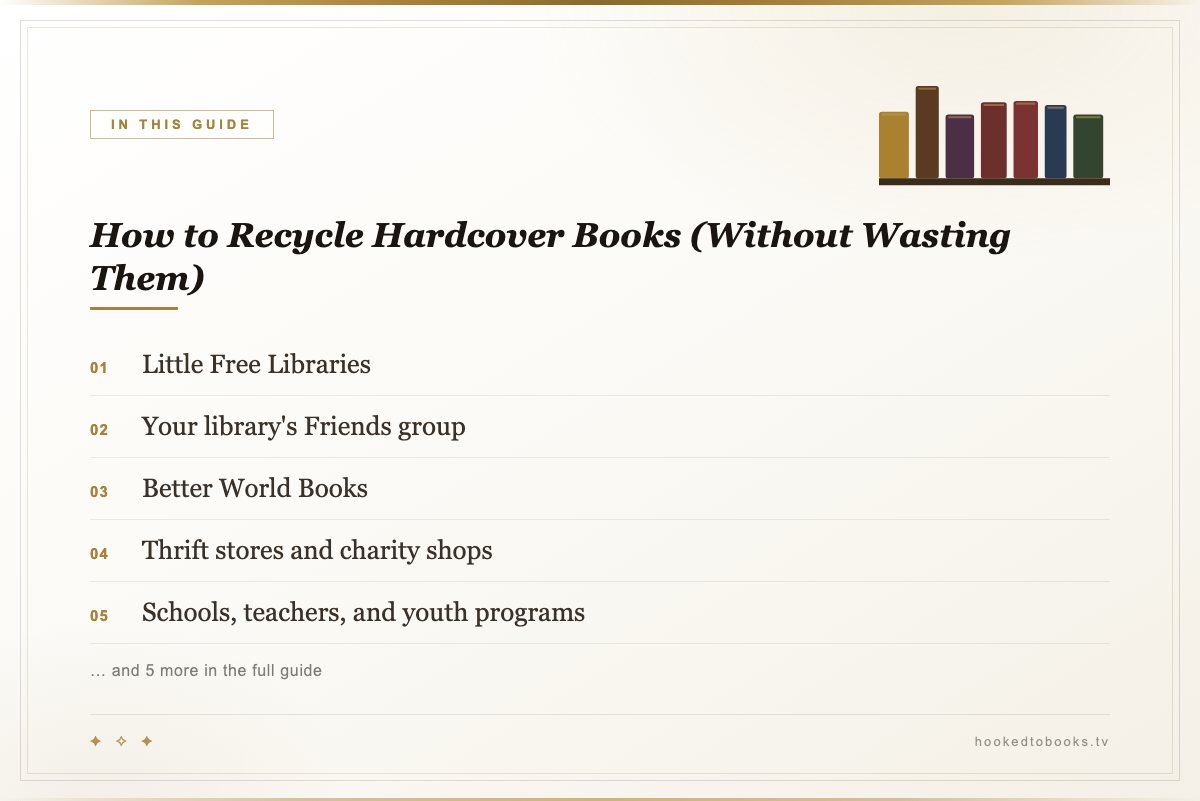
Little Free Libraries
The little boxes on posts around neighborhoods, and by far the lowest-friction option for small quantities. Find one nearby, drop in three or four books, and they'll be gone within days. The etiquette is to add a few at a time rather than dumping twenty — a stuffed box stops circulating. Fiction, kids' books, and popular nonfiction move fastest.
Your library's Friends group
Nearly every public library has a Friends of the Library organization that runs periodic book sales, and the proceeds go straight back to the branch. They usually accept donations year-round or during a stated window. Two things to know: libraries almost never add donated books to their circulating collection (they buy specific editions with specific binding), so this is a fundraiser, not a shelf placement. And they have real limits on what they can sell — call first if you're bringing more than a couple of boxes.
Better World Books
Better World Books operates drop boxes in many US cities and a mail-in program, resells what it can, and funds literacy programs with the proceeds. It's the best single option for a large, mixed box that you don't want to sort yourself, and for books that are decent but not sellable locally. Check their site for the nearest drop box before you drive anywhere.
Thrift stores and charity shops
Goodwill, Salvation Army, Habitat ReStores, and local hospice or animal-rescue thrifts all take books. Quality varies in how they handle them — some sort and shelve carefully, others pallet everything to a bulk buyer — but it keeps books out of the landfill and funds the organization either way.
Schools, teachers, and youth programs
Classroom libraries are chronically underfunded and teachers buy books out of pocket constantly. Children's and middle-grade books in good shape are genuinely wanted. Contact a school's librarian or a specific teacher rather than dropping a box at the front office. Head Start programs, after-school programs, and children's hospitals are worth asking too.
Prison and jail book programs
These exist in most regions and have persistent, unmet demand — particularly for dictionaries, GED and trade study guides, legal reference, and paperback fiction. The important constraint: most facilities refuse hardcovers entirely as a contraband concern, and many require books be shipped directly from a retailer rather than donated in person. Find your local program and read their rules before packing anything.
Shelters, senior centers, and waiting rooms
Domestic violence shelters, homeless shelters, veterans' homes, senior centers, and dialysis and chemo waiting rooms all take books, and these are places where a paperback matters disproportionately. Call ahead — some have storage constraints and some have content guidelines.
Selling, if the book is worth something
Half Price Books buys in person and will make an offer on a whole box, though the offer will be small. Pango Books, eBay, and Mercari work well for individually valuable titles. Before you assume nothing is worth anything, check for first editions, signed copies, out-of-print academic titles, and old cookbooks — those four categories quietly account for most of the surprises. A quick search of a title plus “first edition” takes ten seconds and occasionally pays for dinner.
What nobody wants — be honest about this
Donation centers throw away enormous volumes of donated books, and every one they discard costs them labor and disposal fees. Sorting your own box is a kindness. These categories are effectively unsellable and unlendable:
- Encyclopedia sets. No exceptions, regardless of condition or age. Nobody wants them. They're beautiful and they are recycling.
- Reader's Digest Condensed Books. Printed by the millions, abridged, and unsellable.
- Textbooks more than a few editions old, particularly in sciences, medicine, and law where outdated content is actively harmful.
- Outdated technical and computer manuals. A guide to software that no longer exists is paper.
- Travel guides more than two or three years old. Every restaurant and hotel in them has changed.
- Anything moldy, mildewed, or water-damaged. More on this below.
- Books missing pages, covers, or with heavy writing throughout. Light margin notes are fine and sometimes charming; a highlighted textbook is not.
- Smoke-damaged or heavily perfumed books. The smell doesn't come out and it transfers to everything stored near it.
The mold rule
If a book smells musty, shows fuzzy white or black spotting, or has been wet at any point, it goes in the trash in a sealed bag. This is the one place to be strict.
Mold spores spread readily to dry paper stored nearby, which means a single moldy book can damage a donation bin, a library sale room, or somebody's shelf. Charities won't take them and shouldn't. Mold-contaminated paper is also generally rejected for recycling. Handling moldy books can trigger respiratory reactions in sensitive people, so wear a mask if you're clearing out a wet basement box.
Throwing away a ruined book is not wasteful. Passing a ruined book to someone else is.
Upcycling: what the covers are actually good for
If you've stripped a stack of hardcovers, you now have a pile of sturdy, printed, cloth-wrapped boards, which is a genuinely useful material. And some books are worth keeping intact for a project instead.
Projects that use the whole book
- A hollow book safe. The classic. Glue the outer edges of the text block together with diluted PVA, let it dry under weight, then cut a rectangular cavity with a utility knife and a metal ruler. An old dictionary or a discarded encyclopedia volume is perfect for this — thick, heavy, and worthless otherwise.
- Floating shelves. A hardcover mounted to the wall with a bracket concealed inside makes a shelf that appears to be a book stuck to the wall. Works best with a large, thick volume.
- Book planters. Hollow out as above, line with plastic sheeting, and plant succulents. Not permanent, but striking.
- Risers and pedestals. Stacked hardcovers under a lamp or a plant are the oldest interior-design trick there is, and it costs nothing.
Projects that use the parts
- Bookmarks and gift tags cut from decorative endpapers — the marbled and patterned endpapers in older books are frequently gorgeous and would otherwise be thrown out.
- Coasters made from cover boards cut square and sealed with a few coats of polyurethane.
- Journal and sketchbook covers. A salvaged case rebound around blank signatures is the single most satisfying use for a beloved book with a wrecked interior.
- Wreaths, garlands, and paper flowers rolled from page strips — the standard use for yellowed paperbacks and damaged text blocks.
- Wall art. Vintage cloth covers with embossed spines, hung as a grid, look deliberate and cost nothing.
One request: use damaged, duplicate, or genuinely worthless books for these projects. There's a whole corner of the craft internet built on cutting up perfectly readable books, and it's the one part of this that actually is wasteful.
A five-minute sorting system
For a garage full of boxes, make four piles and don't overthink any single book:
- Sell. First editions, signed copies, recent bestsellers in good shape, popular nonfiction, anything you suspect might be worth money. Ten seconds of searching per book, maximum.
- Donate. Anything readable, current, and clean. This should be the biggest pile by a wide margin.
- Craft. Damaged books with beautiful covers, thick worthless volumes for hollowing out, anything with great endpapers.
- Recycle or trash. Encyclopedias, obsolete textbooks, condensed books, wrecked paperbacks. Strip the hardcovers in this pile; recycle the paper; bin the cases. Anything moldy skips straight to sealed-bag trash.
Then take the donate pile somewhere within a week. The single most common failure mode here is a well-sorted donate pile that sits in the trunk of a car until it becomes a moldy pile.
Recycling books FAQ
Can you put hardcover books in the recycling bin?
Usually not while intact. The board, cloth or laminate covering, and adhesive contaminate the paper stream. Remove the cover and recycle only the block of pages. Paperbacks are generally accepted whole.
How do you remove a hardcover from a book?
Remove the dust jacket, open the front cover flat, and cut down the inner hinge with a utility knife through the endpaper and gauze. Repeat on the back. About two minutes per book.
Where can I donate used books?
Little Free Libraries for small quantities; your library's Friends group; Better World Books drop boxes and mail-in; thrift stores; schools and classroom libraries; prison book programs (paperbacks only, usually); shelters and senior centers.
What should I do with moldy or water-damaged books?
Trash, in a sealed bag. Mold spreads to other books and to the shelves of whoever receives them, and mold-contaminated paper is generally not recyclable.
Are glossy book pages recyclable?
Usually yes — most programs accept magazine-weight coated paper. Laminated pages, toddler board books, and plastic-coated covers are not.
Will the library put my donated books on the shelf?
Almost never. Libraries buy specific editions with library bindings. Donations go to the Friends book sale, where they raise money for the branch instead — still worth doing, just not the same thing.
Is it bad to throw away a book?
Not when the book is genuinely unusable. Moldy, water-damaged, and obsolete books cost charities real money to dispose of when you pass the problem along. Sorting honestly is the m ore considerate act.
More reading guides
Recycling should be the last thing you do with a book, not the first. Donate what's readable, craft with what's broken, strip and recycle what's left, and bin the mold without guilt. Browse all our reading guides for more.
Free printable bookmarks — the zero-waste kind
Print at home on whatever paper you already have, cut, and use. No shipping, no plastic, no packaging — and free.
Get the free bookmarks →Recycling rules vary by municipality — check your local program's accepted-materials list. As an Amazon Associate, we earn from qualifying purchases.